

Views: 0 Author: Site Editor Publish Time: 2026-09-27 Origin: Site


Picture a busy logistics hub. A forklift drops a heavy, irregularly shaped load onto the dock. A worker quickly wraps it in clear plastic. How does that film snap back so tightly, gripping the boxes like a vice? This elastic recovery acts like a giant rubber band. It secures thousands of pounds during rough cross-country transits. Without this inward force, shifting pallets inevitably lead to crushed merchandise and massive operational delays.
Understanding the mechanics behind this elastic recovery goes beyond basic warehouse knowledge. For procurement teams and facility managers, knowing exactly how this package material functions dictates smarter supply choices. It optimizes equipment usage and drastically slashes plastic waste.
PE Stretch Film relies on Linear Low-Density Polyethylene. These specific polymer chains act as microscopic springs to deliver immense elastic recovery.
Stretch memory serves as the core engine for load containment. It ensures pallets remain firmly secured without loosening over rough terrain.
Unlike heat-activated plastics, stretch film relies entirely on mechanical tension to conform to a unique cargo shape.
Utilizing proper tension-control dispensers ensures the plastic reaches its optimal yield point. This activates the memory while reducing material consumption.
Partnering with advanced manufacturers guarantees access to multi-layered nano-extruded films built for demanding industrial environments.
Grasping the physical properties of industrial packaging requires a brief look into polymer engineering. The ability of a plastic wrap to elongate and forcefully revert to its original dimensions is a highly engineered characteristic. It is not an accident.
Modern PE stretch film is predominantly crafted using Linear Low-Density Polyethylene, commonly referred to as LLDPE. Engineers choose this specific grade of plastic for its distinct molecular architecture. Standard low-density polyethylene features long, chaotic branching. In contrast, LLDPE is built with short and uniform branches along a sturdy polymer backbone.
This streamlined structure allows the material to stretch significantly under mechanical stress without tearing. As tension applies, the short branches slide smoothly past one another. This grants the wrap its signature flexibility. On the warehouse floor, this means operators can stretch the film up to 300 percent of its original length while maintaining absolute structural integrity.
The concept of stretch memory is deeply rooted in thermodynamics. In their resting state, the polymer chains sit randomly coiled and tangled. They resemble a microscopic bowl of spaghetti. This disordered state represents their preferred, low-energy configuration.
When a machine or a dock worker pulls the film tightly around a pallet, these chains are forced to uncoil. They align parallel to the direction of the pulling force. Physical systems naturally seek a relaxed state. Therefore, the newly aligned polymer chains immediately fight to recoil. Once the stretching force stops, they desperately want to return to their tangled origin. This continuous and invisible inward pulling force acts exactly like a stretched rubber band. It constantly exerts compressive pressure on the cargo.
When evaluating logistics supplies, buyers often fixate on upfront roll costs or basic thickness. However, for pallet wrapping, elastic recovery supersedes nearly all other performance metrics.
In the freight industry, load containment is the gold standard. It measures the exact amount of holding force applied to a load to prevent shifting during transit. Stretch memory serves as the undisputed engine of this containment.
Consider a pallet loaded onto a semi-truck. It will endure hours of constant vibrations, sudden braking, and sharp highway turns. If a wrapping material lacks memory, it permanently deforms upon the first hard brake. Once the plastic loosens, the load becomes unstable. This inevitably leads to crushed cardboard and severe safety hazards. Because premium PE film possesses high elastic recovery, it acts as a dynamic restraint. If the cargo shifts slightly, the film stretches to accommodate the bump. It then immediately snaps back to hug the boxes tight.
Another tangible benefit of this elasticity is its contribution to puncture resistance. Pallets rarely feature perfectly smooth edges. They often contain sharp box corners, exposed wooden splinters, or irregularly shaped metal machinery.
Pull a rigid sheet tightly over a sharp corner. The stress concentrates at a single point and causes an immediate tear. The elastic nature of LLDPE allows the film to yield slightly around protrusions. The tension naturally distributes across a wider area of the polymer network. Even if a minor puncture occurs, the aligned chains and inherent memory usually stop the tear from zippering across the entire surface.
Before comparing different wrap types, it is crucial to observe current global logistics trends. The packaging industry is experiencing a massive shift toward sustainability and material reduction. Driven by strict environmental mandates and fluctuating resin costs, modern warehouses are abandoning thick, single-layer plastics. Instead, facilities demand ultra-thin, high-performance films. Engineers are now focusing heavily on maximizing molecular alignment through advanced extrusion techniques rather than simply increasing gauge thickness. This evolution allows businesses to cut plastic consumption in half while maintaining the intense compressive force required for heavy-duty freight.
A frequent stumbling block for procurement teams is confusing stretch film with shrink wrap. While both are clear plastics used to secure items, their chemical properties, activation methods, and primary use cases are fundamentally distinct.
Feature | PE Stretch Film | Shrink Wrap |
|---|---|---|
Activation Method | Mechanical tension and kinetic pulling force | Thermal energy via heat guns or industrial tunnels |
Core Material | Linear Low-Density Polyethylene | Polyolefin, PVC, or specialized blends |
Primary Function | Dynamic load containment and pallet securing | Airtight sealing and retail display bundling |
Cost Efficiency | High stretch yield, lower cost per transit load | Higher energy and precise material cost per unit |
The core difference lies in how the materials are activated to generate holding force.
PE stretch film relies entirely on kinetic energy and mechanical tension. As previously noted, operators physically pull it around a load. The securing force comes from the uncoiled polymer chains trying to recoil. No temperature change is required.
Conversely, Shrink Wrap requires thermal activation. Operators drape it loosely over an item. To secure the product, workers apply intense heat via a heat gun or a tunnel. The heat causes the polymer chains to physically shrink. This molds the plastic tightly to the exact contours of the object beneath it.
For high-volume logistics, stretch film is the undisputed champion for securing multiple boxes on a pallet. It offers high breathability and boasts a significantly lower cost per load due to its high stretch yield.
Shrink plastic excels in retail packaging. It is perfect for weatherproofing large outdoor equipment or bundling single items to create a completely sealed barrier.
Not all PE films perform equally on the shipping dock. The degree of elastic recovery a roll possesses is heavily dictated by the specific manufacturing processes utilized.
Factories employ two primary methods for manufacturing this plastic. Each results in vastly different memory profiles.
During cast extrusion, melted resin is pushed through a flat slot die over chilled rollers. The rapid cooling creates a product with excellent clarity, a smooth surface, and a very quiet unwind. Cast film provides highly consistent memory. It remains the most common choice for standard warehousing due to its cost-effectiveness.
Blown extrusion takes a different approach. The melted resin pushes through a circular die and blows vertically outward into a large bubble using air. This multidirectional stretching during the gradual cooling phase creates a highly durable film. It features superior puncture resistance and a remarkably aggressive stretch memory. However, blown wrap is typically cloudier, much louder when unwound, and carries a higher price tag.
Historically, achieving high load containment meant buying thicker and heavier rolls. Today, top-tier Packaging material Manufacturers utilize advanced co-extrusion nano-technology.
Instead of casting a single thick layer of plastic, modern nano-stretch films are constructed from 33 to 55 microscopic layers extruded simultaneously. This intricate layered architecture exponentially increases the elastic recovery and puncture resistance. It allows the overall gauge to drop. For businesses, this means purchasing thinner rolls that yield more wrapped pallets per unit. It ultimately drives down operational costs.
Purchasing premium multi-layered film is only the first step. If the material is applied loosely, the polymer chains will never uncoil. The memory remains dormant. This leads to unstable pallets and damaged goods.
Every roll has a yield point. This is the exact percentage of stretch where the elastic memory is strongest just before structural integrity compromises.
When warehouse workers pull film by bare hand, they rarely achieve more than a 20 percent stretch. This wastes expensive material and completely fails to activate the rubber band effect. Utilizing an industrial Stretch Film Dispenser applies consistent mechanical friction. High-quality manual tools often accommodate standard 15-inch by 1000-foot rolls. With proper tension control knobs, operators can pre-stretch the plastic up to 150 percent manually. This vital pre-stretching ensures the polymer chains are fully aligned to maximize holding force.
Beyond activating the memory, utilizing proper dispensing equipment is a critical safety measure. Wrapping pallets by hand requires workers to bend awkwardly and grip the abrasive cardboard core tightly. This repetitive motion frequently causes friction burns, hand fatigue, and severe back injuries.
Dispensers solve this by providing ergonomic handles and extended reach. Many kits feature rolling squeeze handles that allow the core to spin freely while the operator maintains a firm grip. Workers can maintain a neutral posture while ensuring a uniform, high-tension wrap is applied from the base to the peak of every pallet.
Selecting the correct film means matching the material specifications directly to the weight and shape of your specific load. Abstract specifications must translate into actionable purchasing decisions.
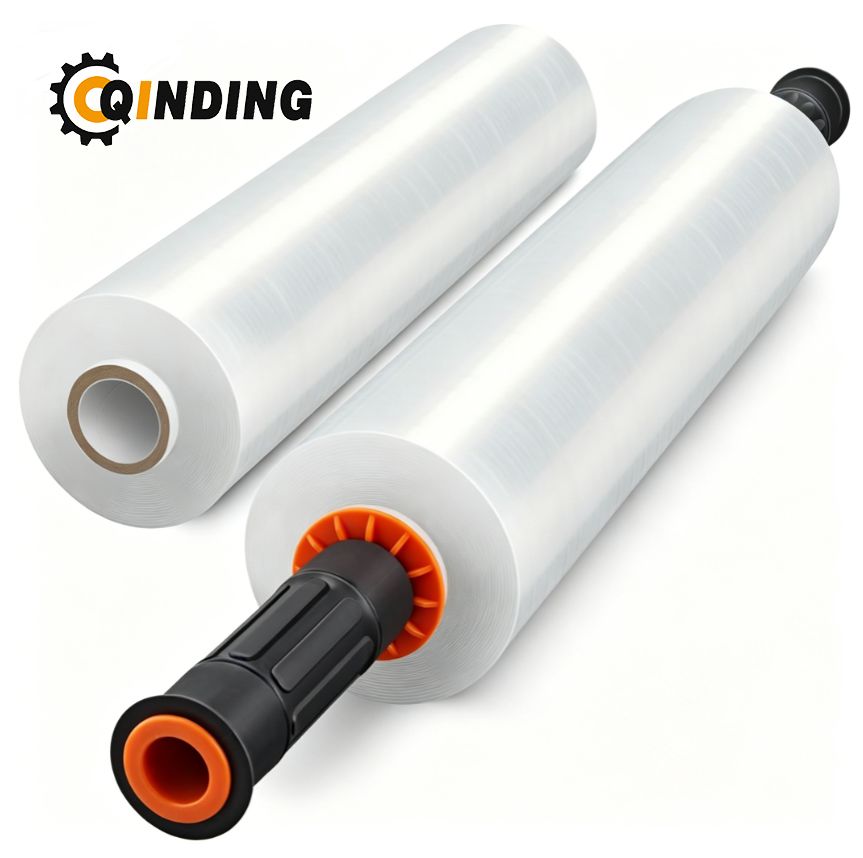
Hand wrap is engineered specifically for manual application. Standard moving and industrial kits often feature 15-inch wide rolls measuring 1000 feet in length. These rolls are lightweight, usually under 10 lbs, to prevent worker fatigue. The resin formulation allows the film to reach its optimal stretch memory with the limited physical force a human can apply.
Machine wrap is built for automated turntable or rotary arm wrappers. These massive rolls often weigh up to 50 lbs. They are chemically engineered to withstand extreme pre-stretch forces applied by heavy-duty automated gears without snapping.
While nano-technology is shifting the paradigm, traditional gauge measurements remain a reliable standard for matching film to load weight. A 37 to 47-gauge film is ideal for uniform, lightweight loads up to 1000 lbs. The industry standard 80-gauge handles mixed warehouse loads up to 2500 lbs effortlessly. For extreme weights, sharp steel parts, or heavy machinery exceeding 3000 lbs, heavy-duty 115 to 150-gauge films provide the necessary compressive force.
Because a roll of clear plastic looks identical across different brands, objective evaluation of the supplier is mandatory to ensure consistent elastic recovery.
Procurement teams should evaluate partners based on empirical data rather than flashy marketing claims. Demand data sheets detailing resin quality. A pure LLDPE core without unverified recycled fillers ensures that every roll performs identically. This prevents sudden wrap failures on the shipping dock.
Look for absolute transparency regarding stretch yields and gauge accuracy. Reputable manufacturers will provide exact specifications on maximum pre-stretch percentages. They guarantee that an 80-gauge film is truly 80-gauge, rather than quietly thinning the material to pad profit margins.
Ultimately, evaluate their ability to provide comprehensive systems. Suppliers that offer bundling solutions demonstrate a profound understanding of load containment engineering. Matching specific high-yield films with the appropriate ergonomic dispensers ensures ultimate warehouse efficiency.
The stretch memory of PE film is a marvel of polymer science. It translates directly into safer, more secure, and highly cost-effective shipping. This dynamic elastic recovery acts as a tireless restraint. It saves businesses money by preventing load shifting and transit damage.
Stop draining your packaging budget on inferior wraps that lose their tension halfway to their destination. Choose reliable solutions engineered for ultimate load containment. Visit Qinding Tools today to browse premium multi-layered films, 15-inch industrial rolls with handles, and ergonomic dispensing equipment. Secure your next shipment with absolute confidence.
Yes, environmental factors can degrade the polymer chains over extended periods. If the plastic is exposed to extreme heat or direct ultraviolet sunlight, the molecular structure undergoes a process called creep. Once the polymers relax, the elastic recovery fades, and the load may become unstable. However, for standard shipping cycles within climate-controlled environments, high-quality LLDPE retains its memory indefinitely.
Temperature fluctuations directly impact polymer behavior. In freezing temperatures, standard stretch film becomes brittle and loses its elasticity, increasing the risk of snapping. Conversely, extreme heat causes the plastic to over-relax, diminishing its holding force. If your freight travels through extreme climates, you must select specially formulated all-weather resin blends designed to maintain memory despite temperature swings.
Compatibility depends entirely on the physical dimensions of the roll. You must ensure that the core diameter matches the spindle specifications of the tool. Standard hand rolls typically feature a 3-inch inner core. Attempting to force an incompatible roll onto a frame will cause uneven unwinding. This completely negates the benefits of controlled pre-stretching.
Cast film provides a consistent, smooth stretch memory that is sufficient for most standard warehouse loads. It unwinds quietly and offers excellent clarity for barcode scanning. Blown film is manufactured through a multidirectional air-expansion process. This gives it an aggressive, high-tension memory and superior puncture resistance. Blown film is ideal for securing heavy, irregular loads with sharp edges, though it is louder during application.
The elongation capacity is dictated by the resin formulation, gauge thickness, and application method. Applied by bare hand, operators typically achieve only a 20 percent stretch. Utilizing a manual tension-control tool pushes that to 100 percent. When high-performance machine-grade plastic runs through an automated pallet wrapper equipped with a motorized carriage, the material can stretch over 300 percent of its original length. This maximizes memory and drastically reduces the cost per load.


